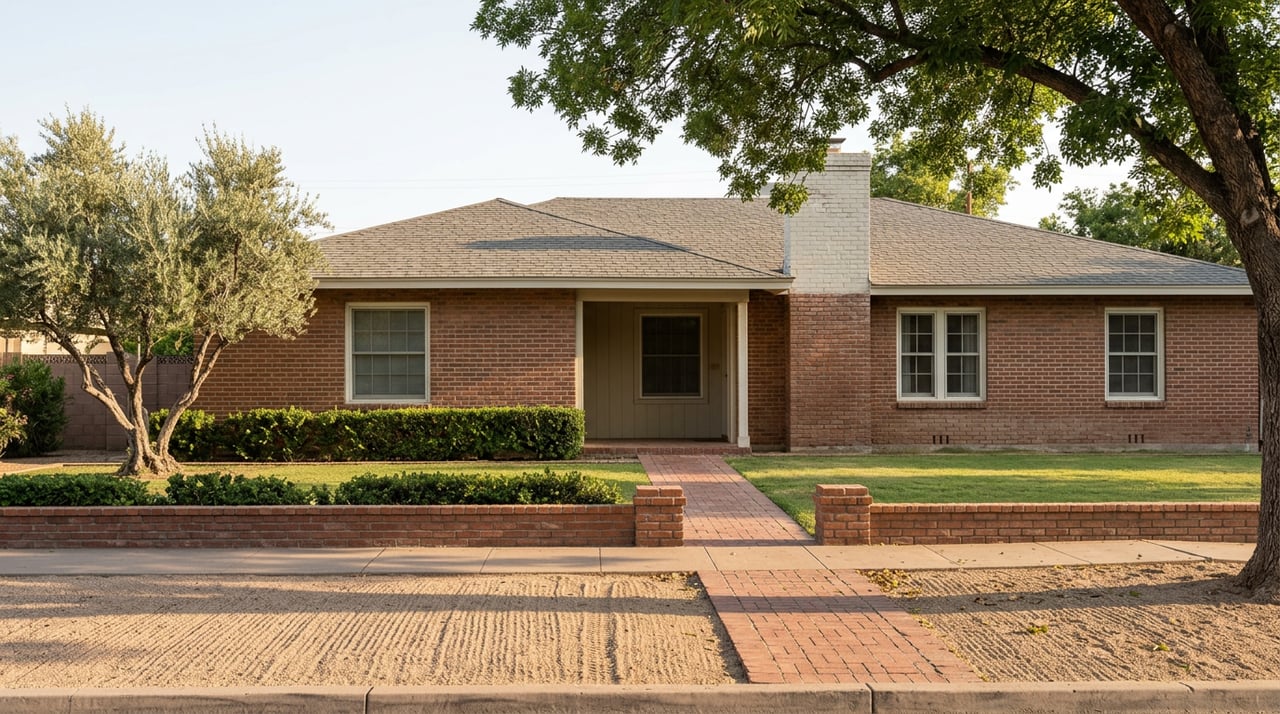
Walk the path on a Saturday morning and you will see the same thing you always see: strollers, a leashed dog or two, someone jogging in the shade of an olive tree that was already decades old when their house was built. What you will not see, unless you know to look for it, is the gravel.
Every entrance along the Murphy Bridle Path, the strip of frontage where a driveway meets the path, is supposed to be quarter-minus granite. Not concrete. Not asphalt. Not pavers. Granite, raked loose, the same material that has covered that ground since before most of the houses behind it existed. It is one of the quieter facts about living on Central Avenue in North Central Phoenix: your front entrance is not fully yours to finish however you like, and the reason goes back to a 1977 city resolution most residents have never read.
The Resolution Behind the Gravel
In 1977, the Phoenix City Council passed Resolution 14895, which states that the Bridle Path shall not be paved over with concrete or asphalt for driveways to residences. Nearly fifty years later, that resolution is still the operating rule, and it is the North Central Phoenix Homeowners Association, not a city inspector, that does most of the enforcing. The NCPHA's own guidance to residents is direct: if a portion of your entrance has been paved over or has fallen into disrepair, remove the asphalt, concrete, or pavers and replace it with the allowed quarter-minus granite.
This is worth sitting with for a second. The path itself sits on land the City of Phoenix owns outright, extending from the edge of the pavement to the property line on either side of Central Avenue. But the look and feel of that land, whether it reads as a historic dirt trail or a patchwork of individual driveway treatments, is maintained almost entirely by the volunteer effort of an association with no zoning authority. The city set the rule in 1977. The neighborhood has been the one holding the line since.
Not Just a Trail, a Registered Landmark
The path itself has a longer pedigree than the resolution that protects its surface. It traces back to W.J. Murphy, who established the Orangewood neighborhood in 1895, planting citrus groves and extending irrigation along what is now Central Avenue. The path that grew up alongside that irrigation lateral now runs the length of the corridor and is listed on both the State and National Register of Historic Places.
According to the NCPHA, it is also the only linear park in the state of Arizona maintained by Phoenix Parks and Recreation. That designation matters because it means the path is not treated by the city as leftover right-of-way or an easement nobody quite owns. It is an actual park, just one that happens to be shaped like a two-and-a-half-mile ribbon instead of a square of grass. At its north end, the path runs into the Arizona Canal, and a separate city effort, the Grand Canalscape project, has added 12 miles of lit, signalized multi-use trail along the Grand Canal elsewhere in the city, so a walk that starts at your own frontage has more than one way to keep going if you want it to.
The Trees Are a Line Item, Not a Backdrop
The canopy over the Bridle Path is not incidental landscaping. Many of the ash and olive trees lining Central Avenue are more than 120 years old, part of the original planting scheme that gave the corridor its shape before Phoenix grew up around it. Keeping that canopy alive costs money, and the NCPHA has put an actual figure on it: the City of Phoenix will purchase, plant, and maintain a 24-inch box ash tree for $350, and the association solicits resident donations to cover replacements the city's own budget does not stretch to.
The economics run in the resident's favor either way. The NCPHA notes that for every dollar spent on an olive tree, the tree returns roughly two and a half dollars in environmental value, mostly in the form of shade and reduced heat load along a street that has no other reason to stay cool in August. A few things follow from this:
- The $350 per tree is not a suggested price, it is what the city actually charges to plant and maintain one 24-inch box ash tree.
- Replacement happens only a few trees at a time each year, because the city's parks budget for the path has been cut in recent years.
- The shade you walk under was planted by someone else's money a century ago, and its replacement is being funded, tree by tree, by the people who live next to it now.
Who Refills the Dog Bags Now
The same pattern shows up in a smaller, more mundane way. Years ago, an Eagle Scout installed doggy-bag stations along the path so residents could clean up after their dogs, a fixture the city used to keep stocked. The City of Phoenix has since stopped refilling those stations because of budget cuts, and the NCPHA is now the one trying to find sponsors, whether residents or nearby businesses, to keep the bags coming. It is a small detail, but it is the same story as the trees and the granite: a piece of the corridor's daily upkeep that used to be a city line item has quietly become a neighborhood one.
What's Actually Changing This Fall
None of this means North Central stands still. Two changes on Central Avenue this fall are worth knowing if you use the path or the corridor's businesses regularly.
The first is at the Uptown Farmers Market, on the southeast corner of Central Avenue and Bethany Home Road, at the North Phoenix Baptist Church, whose parking lot doubles as one of the few formal places to leave your car if you are starting a walk on the Bridle Path from its southern end. The market runs more than 200 vendors on a typical Saturday, making it one of the larger farmers markets in the Phoenix metro area, and its schedule shifts with the seasons.
| Market day | Summer status | What changes |
|---|---|---|
| Saturday | Open, 7 a.m. to 11 a.m. | Runs year-round regardless of season |
| Wednesday | Closed for the summer | Reopens in October |
If you have been wondering why the Wednesday market disappeared, that is the answer, and if you have been meaning to make it back, October is when it returns.
The second change is a few blocks south, on Central Avenue near Colter Street. Joyride Taco House, the SoCal-inspired taco spot that has anchored that stretch since 2013, closed for good on August 2. In its place, two established Phoenix restaurant groups are opening Lado A Lado, a wood-fired Mexican restaurant built around the shared-plate traditions of Sonora. The partnership pairs the Chiwas Hospitality Group, the team behind Tacos Chiwas and Espiritu, with the group behind Postino, one of Phoenix's most recognizable wine bar names. The new restaurant is expected to open this fall, with open-flame cooking as its signature feature.
The Pattern Underneath It All
None of these stories are really about a driveway, a tree, or a taco restaurant on their own. Taken together, they describe a corridor where the things that make it feel distinct, the gravel entrances, the century-old canopy, even the dog bag stations, are increasingly maintained by the people who live there rather than the city that technically owns the ground. That is not a complaint. It is closer to an explanation for why North Central still looks and feels the way it does, decades after other parts of Phoenix paved over their own version of the same path.
If you live along the Bridle Path, that means your own frontage is doing more civic work than it looks like it's doing. If you are thinking about what a home here is actually worth, that same private stewardship is a big part of the answer, and it is the kind of detail that does not show up in a listing description.
If you are curious what your specific property is worth in a corridor where character like this gets factored into every sale, Hull Brothers Realty can walk you through it. Get your instant home valuation and start the conversation from there.